
Ford F-150 Generations: Every Model Year Explained
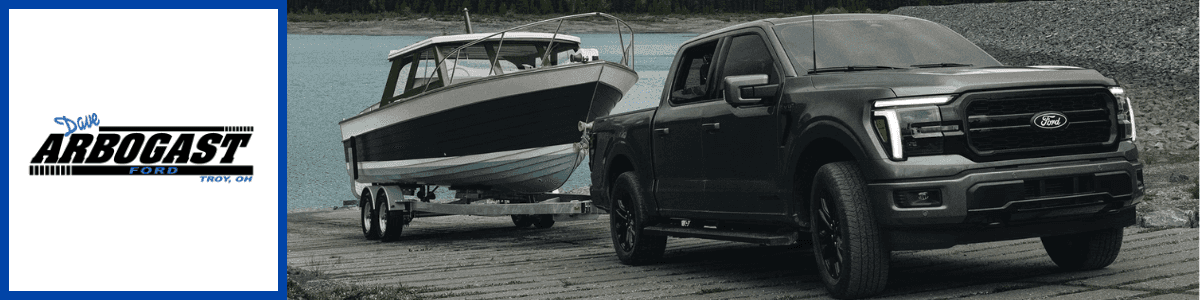
From Bonus-Built Beginnings to Hybrid Power, the Story of America’s Best-Selling Pickup
Ford F150 generations trace a path from a post-war work truck to a hybrid with a built-in generator. Along the way, the lineup picked up new beds, bigger cabs, aluminum panels, and a loyal following. Whether you’re hunting for a used truck or eyeing a new one, knowing what changed and when makes shopping a whole lot easier.
- Ford counts 14 generations of F-Series trucks, and the F-150 name arrived in 1975.
- Big turning points include the 1997 redesign, the 2015 aluminum body, and the 2021 hybrid.
- The chart below covers every generation, with model years and defining details.
Where the F-150 Fits in the Family Tree
Ford launched the F-Series in 1948 as Bonus-Built trucks, sized from the half-ton F-1 up to the heavy F-8. The half-ton pickup became the F-100 in 1953, and the F-150 showed up in 1975 as a higher-payload step between the F-100 and the F-250. Ford says the F-Series has been America’s best-selling truck for 49 consecutive years, from 1977 through 2025. Count every truck since 1948, and the 2021 model kicked off generation number 14, which is still on sale today.
The First Five Generations Set the Blueprint
From 1948 to 1952, the first generation ran on flathead six and V8 power. The F-100 name followed in 1953, along with an overhead-valve Y-block V8 in 1954. Third-generation trucks brought the flat-sided Styleside bed and a factory 4×4 option. The twin I-Beam front suspension arrived in 1965 during generation four and remained on the F-150 through 1996. By generation five, from 1967 to 1972, the cab had grown, and the trim ladder stretched up to Ranger XLT. Pickups were starting to double as family transportation.
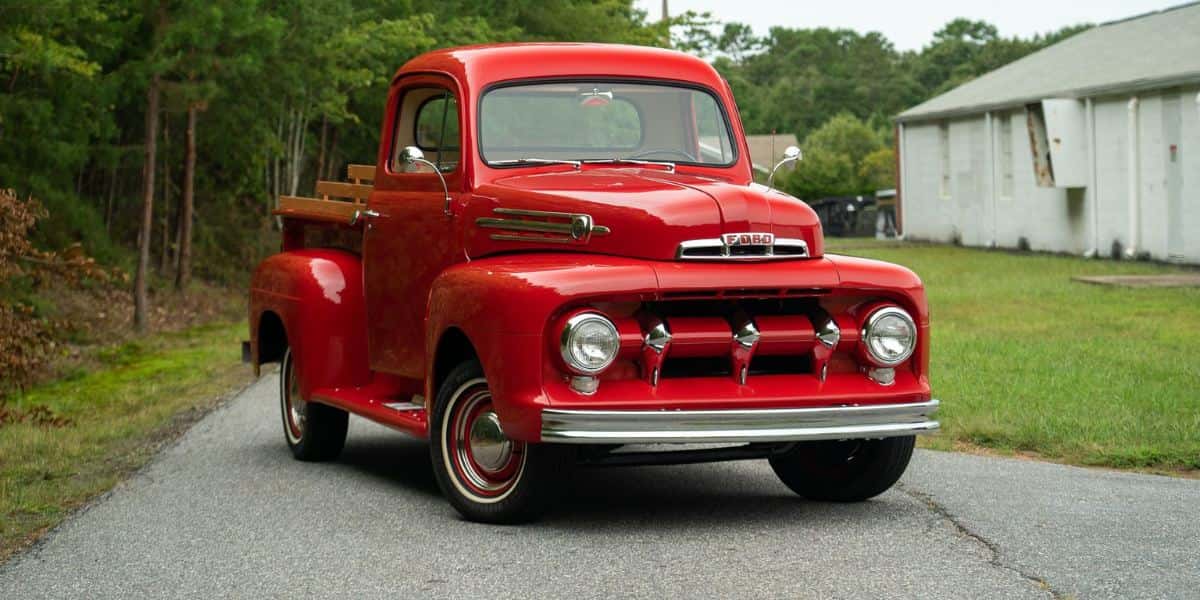
The F-150 Name Arrives and Finds Its Footing
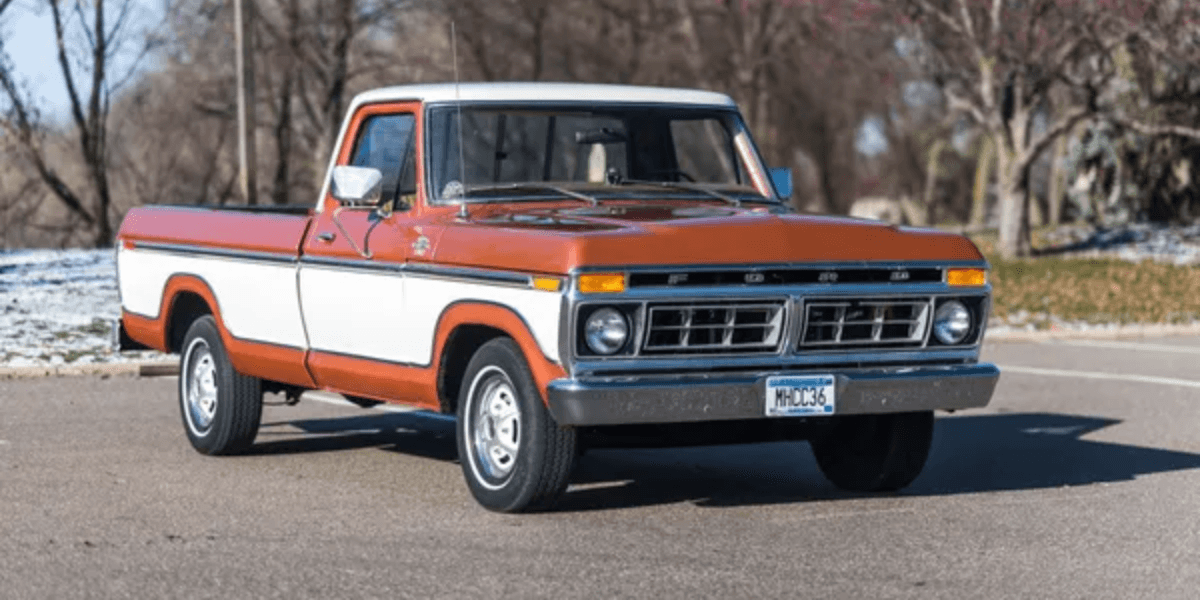
Generation six began in 1973, added the extended SuperCab for 1974, and gave us the first F-150 in 1975. A 1980 redesign, the first ground-up rework since 1965, brought the flat-faced look fans call the bullnose. By 1982, the Blue Oval grille emblem had replaced the hood lettering. Rounder composite-headlamp styling followed in 1987. Then came the Flareside bed’s return in 1992, the SVT Lightning performance truck in 1993, and a driver-side airbag with the 1994 dashboard.
SuperCrews, EcoBoost, and the Raptor Arrive
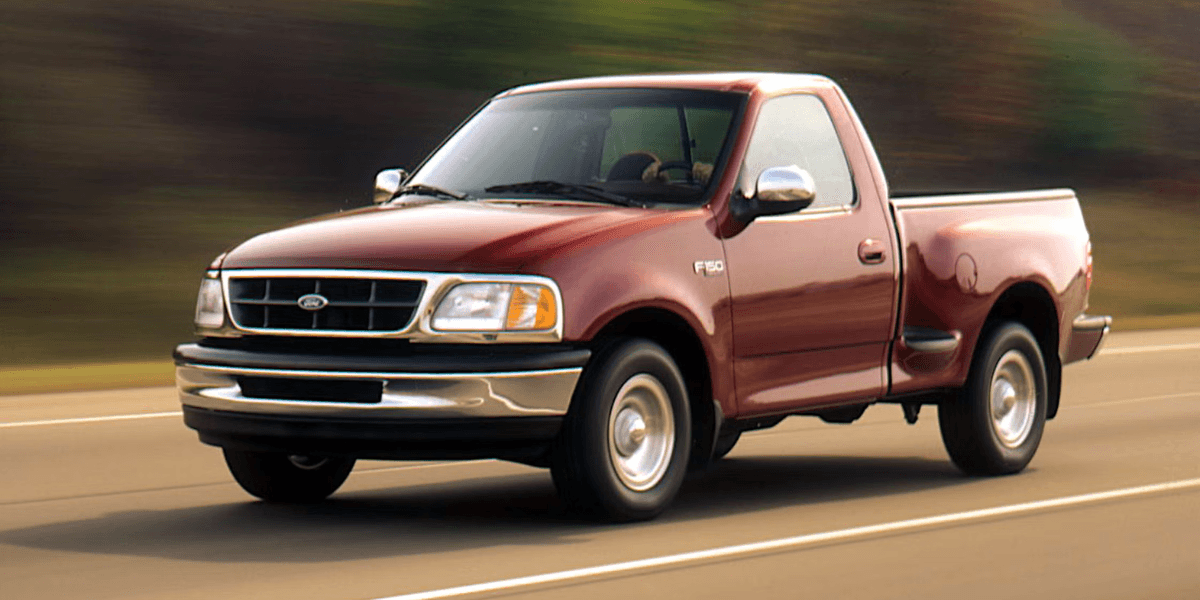
The 1997 redesign was the first ground-up rework since 1979, and it brought Triton V8 power. Four full-size doors were introduced on the SuperCrew for 2001, and King Ranch joined the lineup that same year. A bigger, bolder truck followed in 2004, and 2008 marked the last year for a manual transmission. Twelfth-generation trucks rolled in for 2009, with the SVT Raptor following for 2010. The 3.5L EcoBoost twin-turbo V6 and a new 5.0L V8 landed for 2011.
Aluminum, Hybrids, and Hands-Free Towing
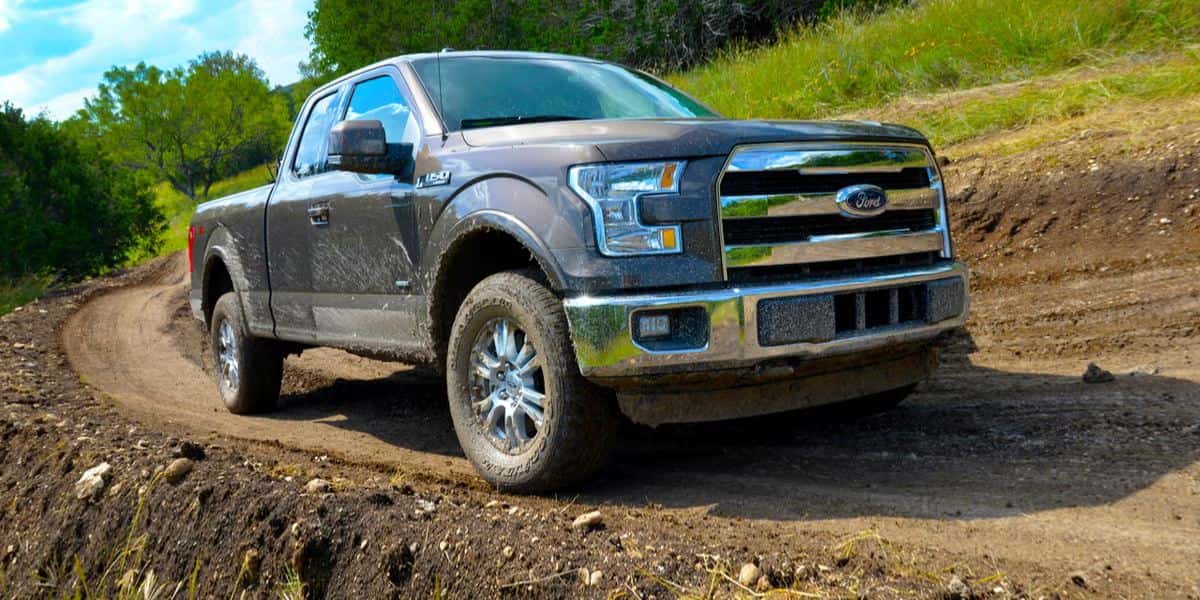
Generation thirteen made headlines in 2015 with a high-strength aluminum-alloy body that trimmed up to 700 pounds. A 2.7L EcoBoost joined the lineup that year, and a 3.0L Power Stroke diesel followed for 2018. The 2021 truck brought the PowerBoost full hybrid, Pro Power Onboard to run tools and appliances, and SYNC 4 with over-the-air updates. Lightning, the electric F-150, ran from 2022 until Ford ended production in 2025. The 2027 model, announced in September 2026, swaps the 2.7L for a 3.0L EcoBoost V6, adds BlueCruise with Towing for hands-free highway towing on qualified roads, and returns the 5.0L V8 to King Ranch and Platinum. A Carhartt edition rounds out the news.
Every F-Series Generation at a Glance
| Generation | Model Years | What Defined It | Engines, Trims, and Firsts |
|---|---|---|---|
| 1st | 1948-1952 | Bonus-Built trucks arrive in eight weight ratings, from the half-ton F-1 up to the F-8. | Flathead six and V8 power at launch. |
| 2nd | 1953-1956 | The F-100 name debuts for 1953 on a redesigned cab. Seat belts became an option in 1956. | Overhead-valve Y-block V8 replaces the flathead V8 for 1954. |
| 3rd | 1957-1960 | A full modernization brings the flat-sided Styleside bed. | The factory 4×4 option began in 1959. |
| 4th | 1961-1966 | A dramatically new body style arrives for 1961. | Twin I-Beam front suspension debuts for 1965 and stays on the F-150 through 1996. |
| 5th | 1967-1972 | A larger cab, sharper lines, and wider engine choices. | Ranger trim, the Camper Special package, and a new Ranger XLT near the end of the run. |
| 6th | 1973-1979 | The F-150 name began in 1975. SuperCab extended cab debuts for 1974, and the F-150 arrives as a higher-payload truck between the F-100 and F-250. | Square headlights joined upper trims in 1978 and became standard for 1979. |
| 7th | 1980-1986 | First ground-up redesign since 1965, with flatter panels and the squared-off look called the bullnose. | Blue Oval grille emblem replaces FORD hood lettering for 1982. |
| 8th | 1987-1991 | Rounder, more aerodynamic front end with composite headlamps. | Every truck gets a straight-sided Styleside bed, and the Flareside bed retired in 1992. |
| 9th | 1992-1996 | Flareside bed returns for 1992. A driver-side airbag arrives with the updated 1994 dashboard. | SVT Lightning performance truck joins for 1993. |
| 10th | 1997-2003 | First ground-up redesign since 1979, with a new chassis and body. A 2004 Heritage version carries the design one more year. | 4.6L and 5.4L Triton V8s arrive. SVT Lightning returns for 1999. SuperCrew with four full-size doors and the King Ranch trim joined for 2001. |
| 11th | 2004-2008 | A bigger, bolder look with styling cues shared with the Super Duty. | Flex-fuel 5.4L Triton V8 arrives for 2006. The 2008 model year is the last for the manual transmission and Flareside bed. |
| 12th | 2009-2014 | All-new chassis and body, plus a big update to the engine lineup. | SVT Raptor debuts for 2010. The 3.5L EcoBoost twin-turbo V6 and a new 5.0L V8 join for 2011. Platinum trim arrives. |
| 13th | 2015-2020 | High-strength aluminum-alloy body on a high-strength steel frame, trimming up to 700 pounds | The 2.7L EcoBoost V6 is new for 2015. Raptor returns for 2017 alongside a 10-speed automatic. 3.0L Power Stroke diesel joins for 2018. |
| 14th | 2021-present | Every body panel is new, and the aluminum-alloy body construction carries over from the 13th generation. | PowerBoost full hybrid and Pro Power Onboard debut for 2021, with 570 lb-ft of torque on the hybrid. F-150 Lightning runs from 2022 to 2025. Raptor R arrives for 2023, and its 5.2L supercharged V8 makes 720 hp from 2024. For 2027, a 3.0L EcoBoost V6 becomes the base engine, BlueCruise with Towing debuts, and the F-150 Carhartt joins. |
Some references list a generation’s start or end year a little differently when a carryover truck overlaps with its replacement, like the 2004 Heritage.
Picking the Best F150 Years for the Way You Use a Truck
Shoppers ask about the best F150 years constantly, and the answer depends on the job. Love classic styling? The bullnose trucks from 1980 to 1986 and the rounded trucks from 1987 to 1996 deserve a look. A modern cab with four full doors points to SuperCrew trucks from 2001 on. Lighter aluminum construction and turbocharged power fit 2015 through 2020. Hybrid power, onboard outlets, and over-the-air updates mean 2021 or newer. Hands-free towing and a 5.0L V8 from XL to Platinum? The 2027 model has both.
Why Buy Your Next F-150 at Dave Arbogast Ford
Here in Troy, Ohio, we carry the full Ford truck lineup, so you can compare generations without leaving the lot. Shop new F-150s, browse Ford Blue Advantage Certified Pre-Owned trucks, or check out our lifted builds like Black Widow by SCA Performance and Shelby Super Snake F-150s. Our finance team also helps shoppers with limited or damaged credit, and we offer nationwide delivery if you’re shopping from a distance. Stop by, tell us how you use a truck, and we’ll point you toward the model year that fits.
Frequently Asked Questions
How many generations of the Ford F-150 are there?
Ford counts 14 generations of the F-Series. The F-150 name was introduced in 1975 during the sixth generation, and the current generation began in the 2021 model year.
When did Ford start making the F-150?
Ford introduced the F-150 in 1975 as a higher-payload truck positioned between the F-100 and the F-250. The F-Series itself dates back to 1948.
Which F-150 generation first used an aluminum body?
The 13th generation, which started with the 2015 model year. It paired a high-strength aluminum-alloy body with a high-strength steel frame. The aluminum-alloy body carries into the current generation.
When did the F-150 get a hybrid option?
The PowerBoost full hybrid arrived with the 2021 model year, the first year of the current generation. It pairs a 3.5L twin-turbo V6 with an electric motor. Pro Power Onboard is available for powering tools and equipment.
What are the best F150 years to buy?
It depends on how you use the truck. Trucks from 2015 through 2020 bring the aluminum body and turbocharged engines. Trucks from 2021 forward add hybrid power, Pro Power Onboard, and SYNC 4 with over-the-air updates. The 2027 model adds BlueCruise with Towing.
Does Dave Arbogast Ford sell used and lifted F-150 trucks?
Yes. We offer new F-150s, used trucks, Ford Blue Advantage Certified Pre-Owned trucks, and lifted builds like Black Widow by SCA Performance and Shelby Super Snake F-150s. Contact us to see what’s on the lot today.

0 comment(s) so far on Ford F-150 Generations: Every Model Year Explained