
Ford Bronco vs Bronco Sport: Real-World Differences That Matter
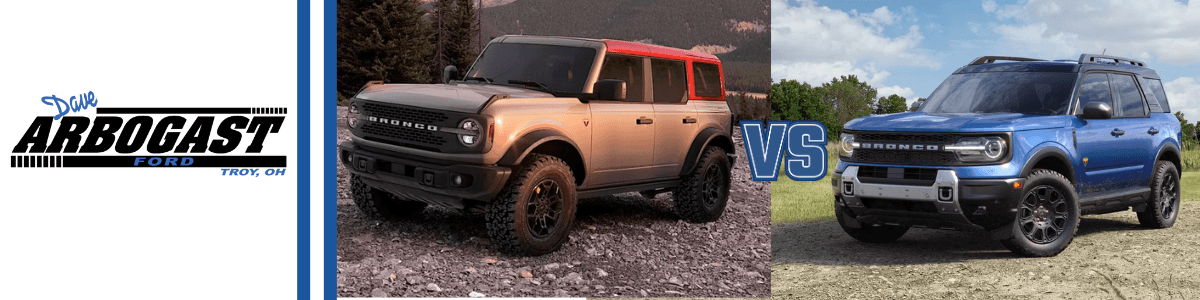
Same Wild Badge, Two Very Different Trucks
Walk onto the Dave Arbogast Ford lot in Troy, Ohio, and you’ll spot two SUVs wearing the same name but built for two very different drivers. The full-size Bronco looks like it was chiseled out of bedrock. The Bronco Sport feels lighter and sharper, sized for school drop-offs and Saturday hardware store runs. Both can handle a muddy weekend without breaking a sweat, but they take wildly different roads to get there.
- The full-size Bronco rides on a body-on-frame truck platform with removable doors and removable roof panels.
- The Bronco Sport uses a unibody crossover platform with standard 4×4 and friendlier fuel economy for daily driving.
- Pricing, towing, ground clearance, and engine choices separate the two in ways that actually shape how you use them.
The Platform Story
The split between these two happens right at the foundation. The big Bronco shares its bones with the Ford Ranger and sits on a fully boxed truck frame. That construction is what lets the doors and roof panels pop off for open-air drives. Side mirrors mount to the cowl, so they stay put even when the doors are stashed in your garage.
The Bronco Sport rides on Ford Escape bones. It’s a unibody crossover, which means a quieter highway ride, better gas mileage, and easier parking at the Troy Kroger. The catch? You can’t pop the doors off for a sunny Saturday cruise.
Engines and What They Pull
Let’s compare engine specs and Ford Bronco vs. Bronco Sport MPG. Pop the hood on a base full-size Bronco, and you’ll find a 2.3L EcoBoost four-cylinder rated at 300 horsepower and 325 lb-ft of torque on premium fuel. Move up the ladder, and you can opt for a 2.7L twin-turbo V6 at 330 hp and 415 lb-ft. Want the wild one? The Bronco Raptor packs a 3.0L twin-turbo V6 cranking out 418 hp and 440 lb-ft. Max towing comes in at 3,500 pounds for non-Raptor trims, or 4,500 pounds for the Raptor when properly equipped.
The Bronco Sport keeps things lighter. A turbocharged 1.5L EcoBoost three-cylinder makes around 180 hp on the Big Bend, Heritage, and Outer Banks. Step up to the Badlands, and you get a 2.0L EcoBoost four-cylinder reported to deliver around 250 hp (worth a dealer check, since Ford hasn’t published an official 2026 figure). Max towing is 2,200 pounds. Where the Sport pays you back is at the pump, with EPA ratings of 25 city and 30 highway on 1.5L trims.
Off-Road Chops
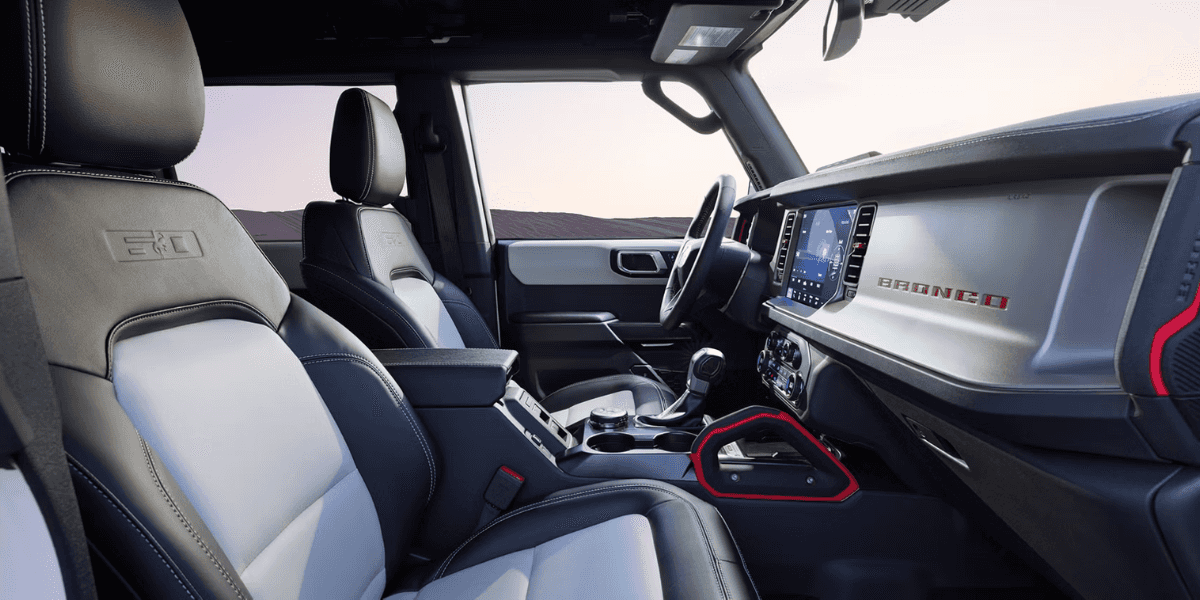
If you’re picturing rock crawling at Hocking Hills or running through deep mud somewhere south of Dayton, the Ford Bronco vs Bronco Sport question becomes pretty easy to answer. The full-size Bronco was designed from day one as a trail rig. Badlands and Raptor trims stack on front and rear electronic-locking differentials, the HOSS suspension system, and ground clearance that climbs to 11.6 inches with the Sasquatch Package. The Raptor wears 37-inch tires straight from the factory.
The Bronco Sport Badlands isn’t a soft city crossover either. It runs HOSS off-road suspension, an upgraded rear differential, steel skid plates, and recovery hooks. Ground clearance sits at 7.8 inches, and the G.O.A.T. drive modes route power to the right wheels for snow, sand, and mud. It caps out roughly where the big Bronco is barely warming up, which is fine if your idea of off-road is a forest service road, not a boulder field.
Size and Daily Driving
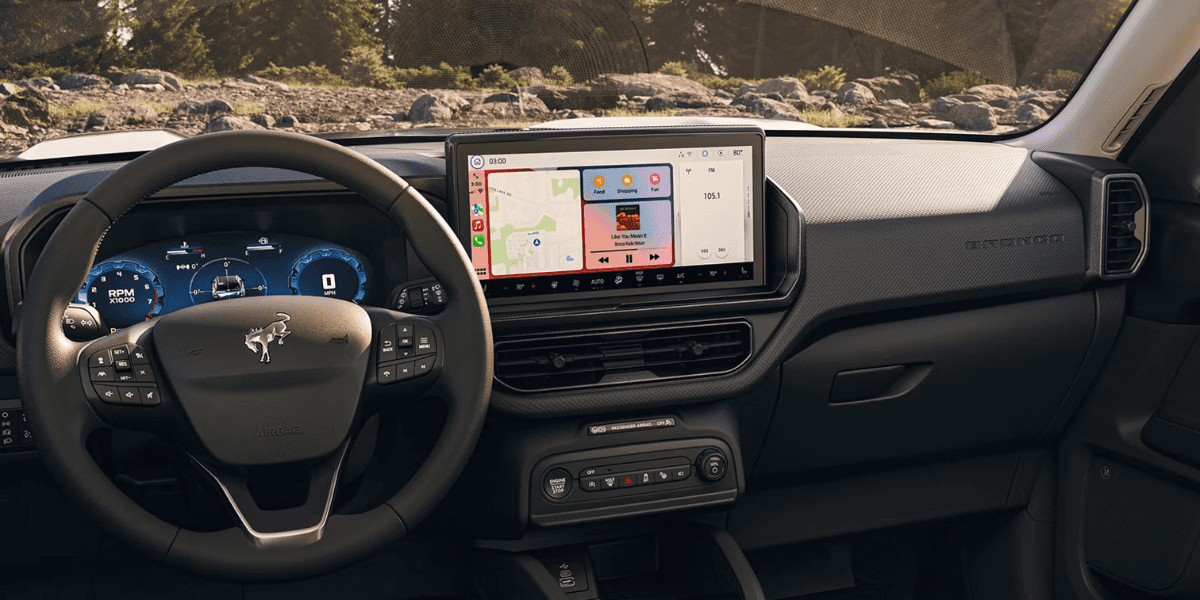
The two-door big Bronco stretches 173.7 inches, while the four-door grows past 189 inches and tops out at 191 inches on the Raptor four-door. The Bronco Sport runs 173.1 to 173.4 inches, so it sits about the same length as a two-door Bronco, but the Sport’s body is narrower at 74.3 inches versus the big Bronco’s 86.3-inch width. That means tight downtown Troy parking spots and home garages are a whole lot friendlier to the Sport.
How They Stack Up by Trim
| Trim Level | Ford Bronco | Bronco Sport |
|---|---|---|
| Base / Big Bend | Base from $40,495, Big Bend from $40,995. 2.3L EcoBoost, 300 hp, 7-speed manual or 10-speed auto, standard 4×4. | Big Bend from $31,845. 1.5L EcoBoost, around 180 hp, 8-speed auto, standard 4×4. |
| Heritage | Heritage Edition from $51,625. Retro styling, vintage badging, available 2.3L or 2.7L, four-door body. | Heritage from $33,395. Plaid cloth seats, white grille with red lettering, white wheels with all-terrain tires. |
| Outer Banks | Outer Banks from $48,090. Leather-trimmed seats, 12-inch SYNC 4 screen, 18-inch wheels, available 2.7L V6 at 330 hp. | Outer Banks from $35,145. Heated front seats, 18-inch wheels, LED foglights, remote start, dual-zone climate. |
| Badlands | Badlands from $48,890. Front and rear electronic-locking diffs, HOSS suspension, available 33-inch or 35-inch tires with Sasquatch Package. | Badlands from $37,265. 2.0L EcoBoost (around 250 hp), HOSS off-road suspension, steel skid plates, recovery hooks. |
| Stroppe / Raptor | Stroppe Edition from $69,995. Raptor from $79,995 with 3.0L twin-turbo V6 at 418 hp and 37-inch tires. | Not offered on the Bronco Sport lineup. |
All prices exclude the $1,995 destination charge. Check with us to confirm current pricing.
Test Drive Both at Dave Arbogast Ford
Picking between these two gets a whole lot easier once you sit in both. Stop by our Troy showroom, and we’ll line up side-by-side test drives so you can feel the difference between body-on-frame muscle and unibody comfort. Our team will walk you through pricing, current Ford incentives, and packages without any pressure.
Tow a boat to Indian Lake or haul gear for fall hunting trips, and the full-size Bronco earns its keep. Want quick getaways with the kids, fuel mileage that doesn’t sting, and back roads after a fresh Ohio snow? The Bronco Sport is the smarter pick. Either way, you’re getting a Built Wild SUV with serious off-road bloodlines, and we’re happy to help you find the one that fits your driveway.
